
A-Rod vs Everyone Else
A new docuseries on the life and baseball career of Alex Rodriguez seems to be missing a few voices and pieces

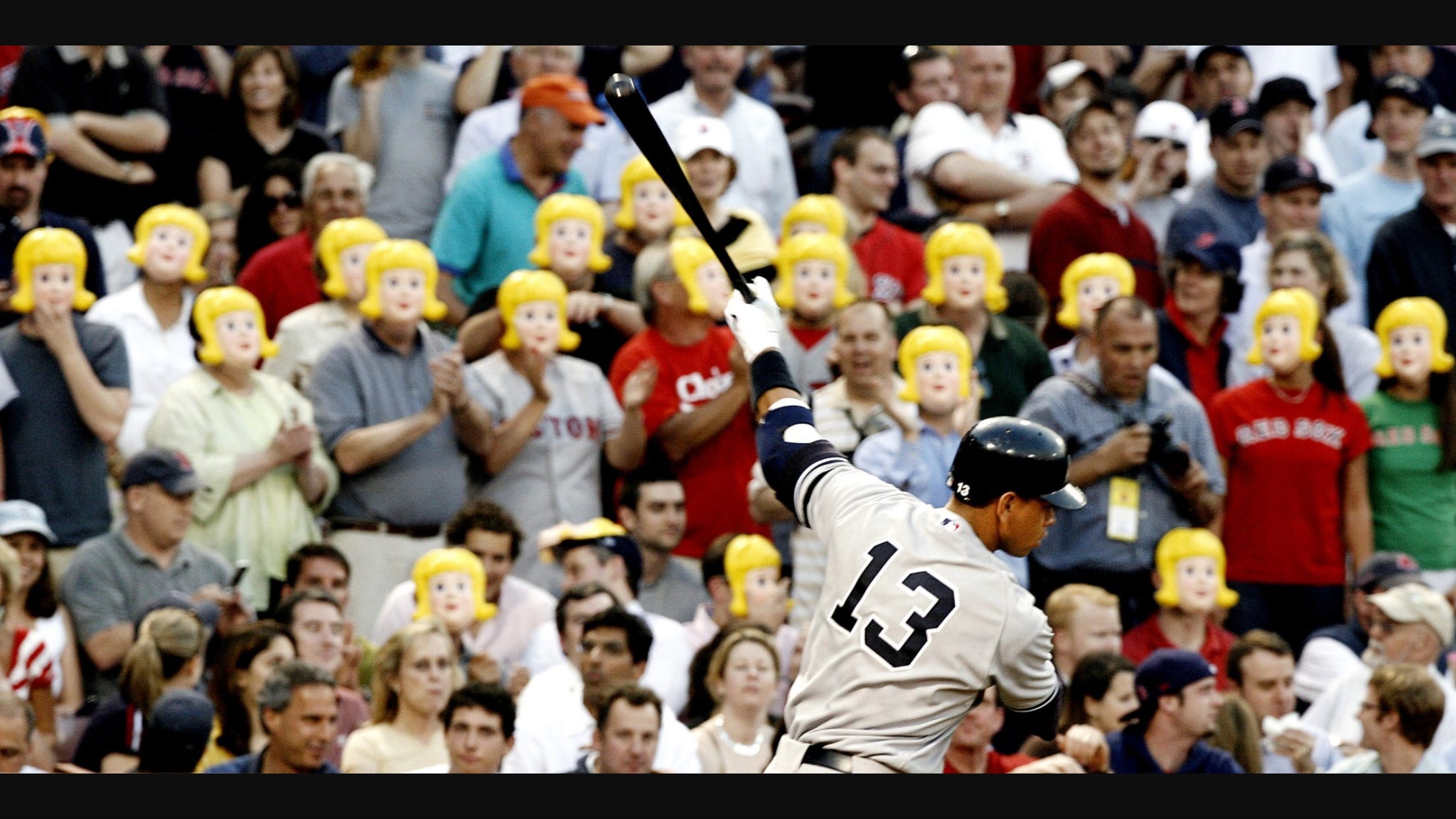
(Alex Rodriguez at Fenway Park in 2007. Photo courtesy of Corey Sipkin)
You may have heard Alex Rodriguez has a new HBO docuseries out, ALEX vs AROD, a warts-and-all, three-part baseball story about the former Yankees slugger.
Check that.
“More of a mental health story than a baseball story,” Rodriguez said recently on the “Today” show during his promotional blitz.
Yes, the steroid-stained retired major leaguer nicknamed “A-Rod,” who amassed a Hall of Fame-worthy statistical resume — “Today” show host Craig Melvin opened his interview segment with Rodriguez by calling the three-time American League MVP a “towering figure in the history of baseball” and displayed A-Rod’s gaudy numbers in a graphic — only to flush that baseball legacy down the drain through his performance-enhancing drug use and self-admitted “stupidity,” has splashed his life and career arc on the screen for all to see.
Number one pick in the 1993 draft. Young Seattle Mariners star alongside future Hall of Famers Ken Griffey Jr., Randy Johnson and Edgar Martinez. Record $252 million contract. Blockbuster trade to the Yankees. Endless NYC tabloid headlines. Infidelities. Playoff futility. World Series champion. PED user. Record baseball suspension. Fall from grace. Post-playing days redemption tour.
But while Rodriguez, 50, opens up about his complicated past and seems resigned to the idea that his Cooperstown plaque will never be — during his press junket rounds he said numerous times some variation of his “Today” show comment: “I’m definitely not going in the Hall of Fame” — and although Rodriguez uses the words “raw” and “real” to describe the docuseries’ tone, the project still feels incomplete on several levels.
Kind of like an asterisk needs to be affixed somewhere.
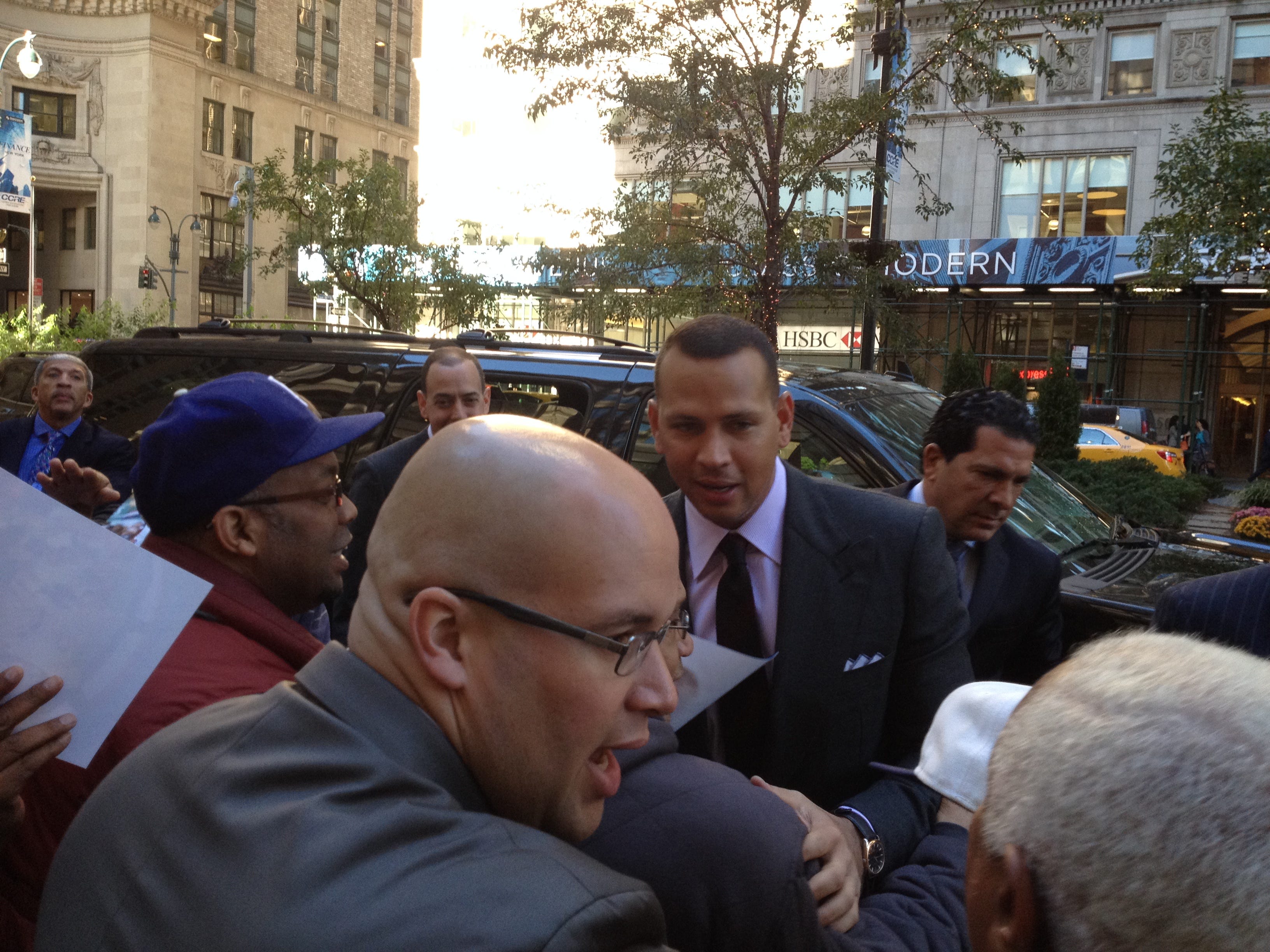
(Alex Rodriguez outside Major League Baseball’s Park Avenue offices in 2013, during his arbitration hearing to fight a record doping suspension. A-Rod attorney Joe Tacopina is behind Rodriguez on r.)
Start with the list of participants in the press release: Mike Francesa. Katie Couric. Lou Piniella. Derek Jeter. Griffey Jr. Michael Kay. Rodriguez’s two daughters, Natasha and Ella. His ex-wife Cynthia.
Nary a baseball writer. No Yankees executives like team president Randy Levine or general manager Brian Cashman. No former baseball commissioner Bud Selig. No Biogenesis mastermind Anthony Bosch. No super agent Scott Boras. No Cousin Yuri Sucart. No defense attorney Joe Tacopina. No ex-brother-in-law Constantine Scurtis. No J-Lo. No Kate Hudson.
The list goes on.
Sure, Francesa calls Rodriguez an “incredibly-flawed individual” in the trailer, and Rodriguez’s former “frenemy” Jeter is unplugged on all things A-Rod. Yes, Rodriguez comes clean on the consequences that came with his decisions to juice, and he says that he’s a better person and father because of his tangled past. And he divulges his years-long commitment to therapy, something that he says is still ongoing.
“Therapy has really saved my life,” Rodriguez said on “The View.”
The thing is, if you’re going to do a warts-and-all docu, all the more reason to include some of the people that were tied to or were responsible for the warts, in addition to those who helped contribute to your triumphs, milestones and successes. Add some more objective voices to the mix, too. That would lend more of an air of authenticity.
In fairness, at least one published report said that Selig and Boras “declined interview invitations,” and Tacopina, Rodriguez’s lead attorney during his 2013 arbitration hearing to fight a record drug suspension, said in a text message that he was approached for an interview but took a pass.
“I am still close with Alex and am happy for his well-deserved success, especially after what he went (through),” Tacopina wrote.
No spoiler alert: I do not appear in ALEX vs AROD. I covered Rodriguez’s entire Yankees arc — from his arrival via a 2004 trade to his 2016 release by the team — for the Daily News and wrote plenty about his playing career as well as his myriad off-the-field foibles. After Rodriguez was jettisoned in ’16, I wrote dozens more A-Rod stories, including covering the years-long legal battle between Rodriguez and his ex-brother-in-law, Constantine Scurtis (Cynthia’s younger brother). Those articles appeared in three different outlets before a settlement was reached between the parties in 2021.
All of that certainly doesn’t qualify me to be included in A-Rod’s screen memoir.
The bigger puzzle, however, is why Yankees (and Texas Rangers and Seattle Mariners) beat writers and national baseball writers/columnists were left out. (Kay, the longtime YES broadcast voice, was a former Yankees beat writer, but over three decades ago). One of my sportswriting peers joked before the A-Rod docuseries release, “I’m guessing few if any New York writers were” interviewed.
ALEX vs AROD, it appears, was done on Alex’s/A-Rod’s terms.
“Everything (Rodriguez) does has everything to do with image. And why not?” Anthony Bosch, the Biogenesis founder whose South Florida anti-aging clinic was the epicenter of the PED sports scandal that engulfed Rodriguez and other pro baseball players, said during a recent phone interview. “He’s already famous. He already has money. Strictly, in my opinion, it’s for image. He keeps on chasing that. That he has episodes of resentment, or regret, or episodes of, ‘Oh my God,’ an awakening, sure, I believe that.
“But at the end of the day, a tiger doesn’t change its stripes.”
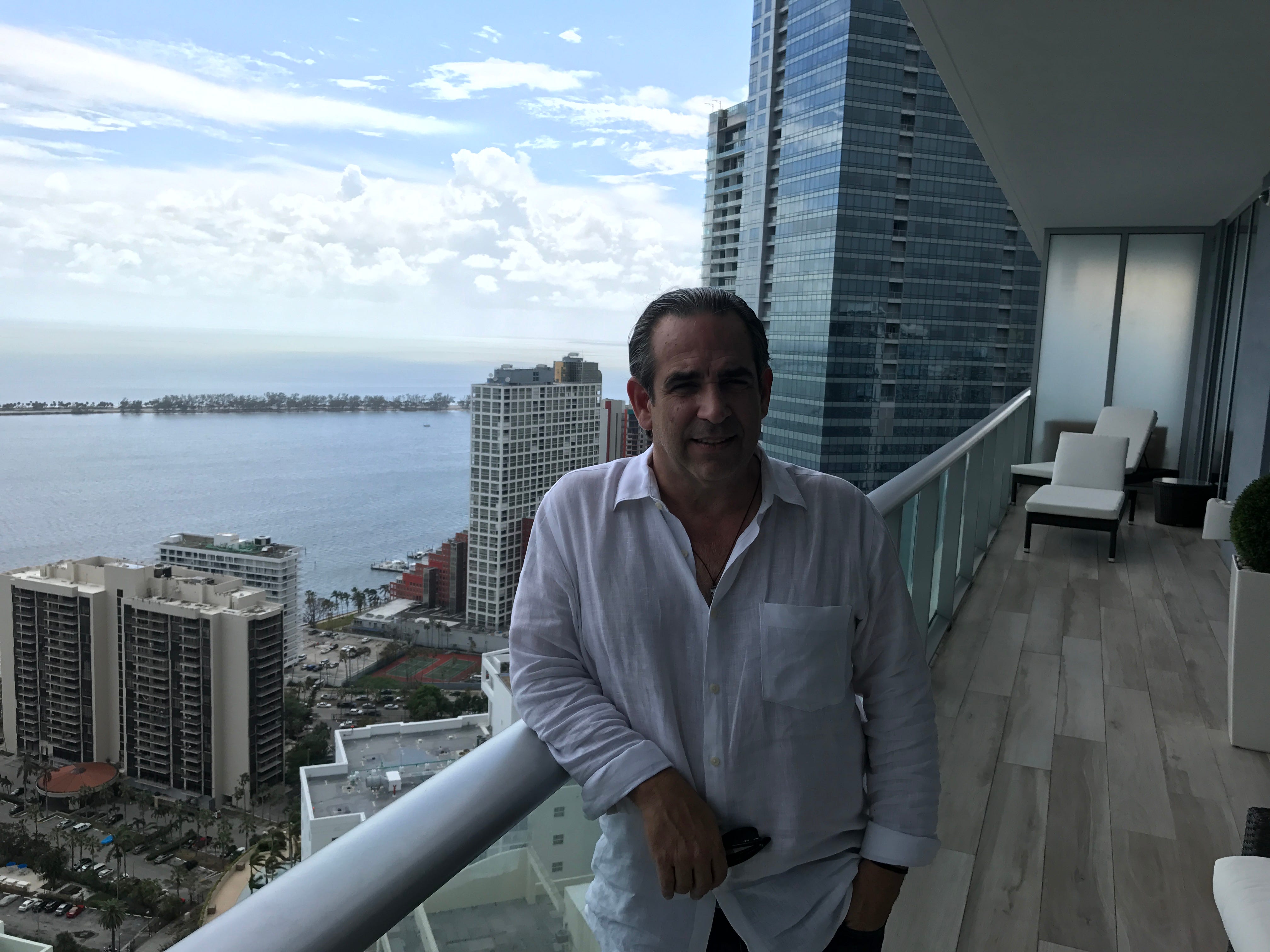
(Biogenesis founder Anthony Bosch in 2017)
Bosch, 62, said he was not approached for the A-Rod docuseries. After Bosch served as Rodriguez’s drug supplier for two years (2010-2012) — according to court documents that were part of a federal lawsuit Rodriguez filed against MLB, Selig and the Players Association — he became a key witness against A-Rod during the latter’s 2013 arbitration hearing.
The Drug Enforcement Administration (DEA) and MLB conducted separate investigations of Biogenesis and Bosch, and in the fallout, Bosch served prison time after he pleaded guilty in the federal case. Rodriguez’s cousin, Yuri Sucart — who was first introduced to the public during A-Rod’s 2009 PED mea culpa press conference — was another defendant in the Biogenesis federal case and also pleaded guilty to federal drug charges. Sucart, like Bosch, served time behind bars.
But Rodriguez avoided jail and any criminal charges in that scandal. With attorney Tacopina at his side, Rodriguez signed a partial immunity agreement in January 2014 and was interviewed by DEA agents in the Weston, Florida field office.
“I was pretty impressed with A-Rod,” former DEA agent Kevin Stanfill said in a 2017 interview for a book I co-wrote with Eddie Dominguez and Teri Thompson called Baseball Cop. “(Rodriguez) gets such a bad reputation. When the time came, A-Rod manned up.”
Yes, when you’ve got the feds in pursuit, it’s pretty easy to man up. Rodriguez’s “Queen for a Day” immunity deal came only weeks prior to serving his season-long baseball suspension.
Rodriguez, of course, famously fought that punishment in the contentious 2013 arbitration hearing that played out over two months at the league’s Park Avenue offices (MLB has since moved headquarters). When the arbitration began, there were dozens of A-Rod supporters who were part of “Hispanics Across America,” an organization founded by activist Fernando Mateo.


Rodriguez famously left the arbitration process on the penultimate day and fled to the safe harbor of WFAN personality Mike Francesa.
“Let’s get that on the record. You say you did not do these PEDs that they are accusing you of doing?” Francesa asked Rodriguez during that 2013 interview.
“You’re correct, Mike,” said Rodriguez.
Oops.
A-Rod used that same interview to clap back at then baseball commissioner Selig, who Rodriguez called “the man from Milwaukee.”
You won’t hear Selig’s or Mateo’s side in ALEX vs AROD, though. Mateo said he was not approached for an interview.
Rodriguez says in the docuseries that he initially declined Bosch’s offer to use human growth hormone, according to a New York Post report (below link).
[https://nypost.com/2025/11/05/sports/alex-rodriguez-docuseries-offers-open-book-and-stunning-yankees-admission/].
“At the time, I knew it was a very, very risky thing to do,” Rodriguez said, according to the Post. “But if this is actually going to make me feel better and help me get out of bed and help me not be in pain, then f–-k it. I’ll risk it.”
The MLB investigation of A-Rod and his association with Bosch and Biogenesis was made public when Rodriguez filed that federal lawsuit against the league, Selig and the players’ union in early 2014. (Rodriguez was still a union member at the time).
Attached to the lawsuit was independent arbitrator Fredric Horowitz’s ruling on A-Rod’s appeal of his 211-game suspension (the original punishment Selig leveled at Rodriguez). Arbitration proceedings are supposed to remain confidential.
Horowitz upheld the suspension and reduced the amount to 162 games. But the juicier details of the ruling were MLB’s findings, including the complete doping regimen that Bosch prepared for A-Rod. It was a lot more than just growth hormone: oral testosterone “troches” (lozenges), testosterone cream, insulin growth factor (IGF-1), peptides, DHEA and Clomiphene, a female fertility drug.
[https://embed.documentcloud.org/documents/1004827-ar-complaint/?mode=document&embed=1#document/p76]
The ruling (above link) also included Selig’s 2013 letter to Rodriguez announcing the record suspension, but in the letter, Selig tells A-Rod that he should be “aware that the office of the Commissioner continues to actively investigate allegations that you violated the Program (Joint Drug Agreement) in 2009 by using and possessing Prohibited Substances that you received from Dr. Anthony Galea, and whether you lied to representatives of the office of Commissioner during your April 1, 2010 and August 26, 2011 investigatory interviews on that subject. If I believe that additional discipline is warranted based on that investigation, I will issue a separate notice of discipline.”
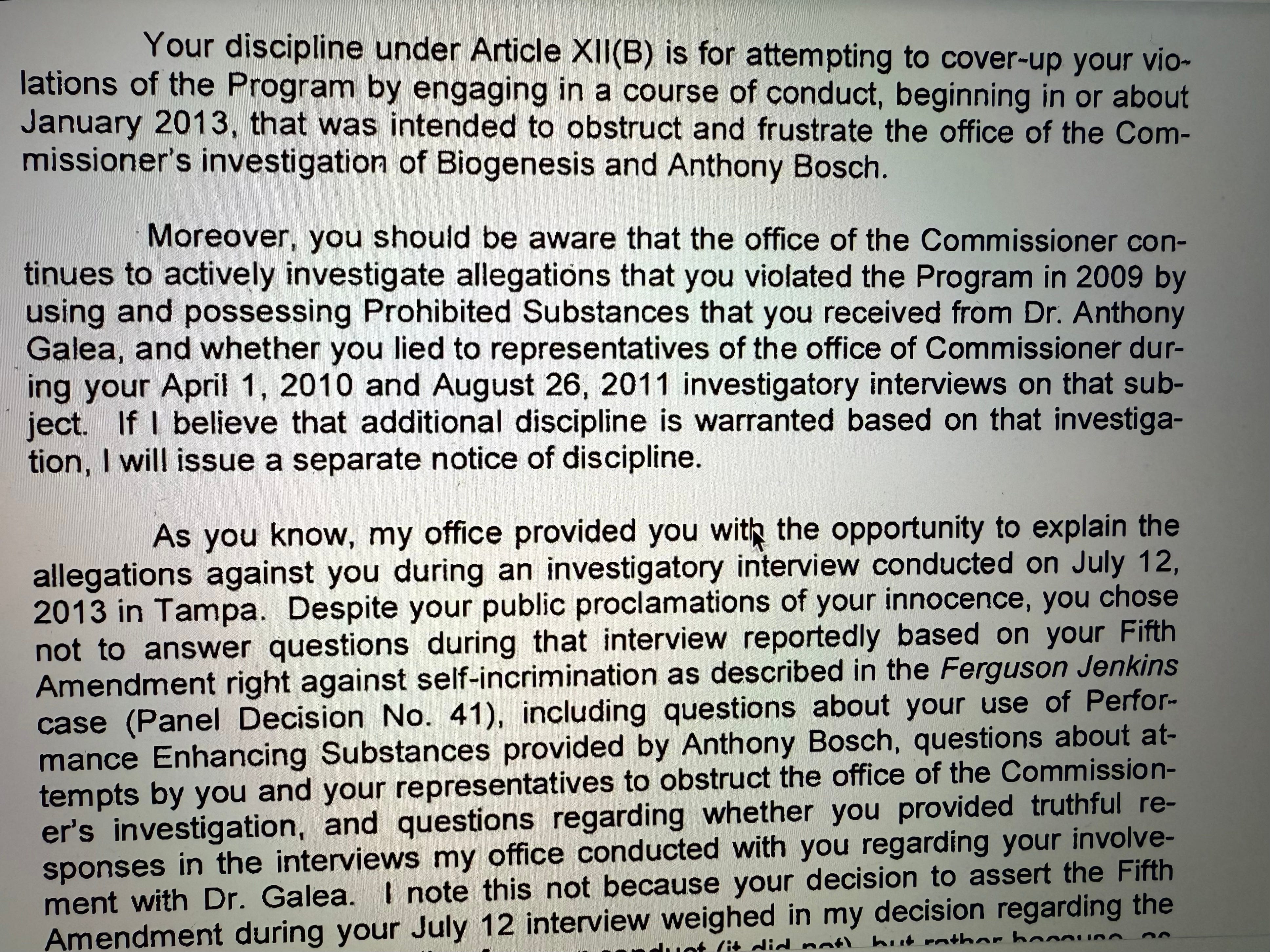
(A portion of Bud Selig’s 2013 letter to Alex Rodriguez announcing his historic suspension. The letter was part of independent arbitrator Fredric Horowitz’s ruling which upheld Rodriguez’s PED suspension. The ruling was attached to a federal lawsuit A-Rod filed in early 2014, the same year he served his season-long ban from baseball.)
Rodriguez was never punished further, either by Selig or Selig’s successor, Rob Manfred. But the fact that Selig cited 2009 and the Galea probe in his letter is notable.
Early in 2009, a bombshell Sports Illustrated report outed A-Rod as a PED user for the first time. The report said Rodriguez tested positive for synthetic testosterone and the anabolic steroid Primobolan during baseball’s 2003 survey testing year, conducted to determine if a drug-testing policy with penalties would be implemented.
After the SI report, Rodriguez held his Tampa spring training presser — where he apologized and identified his cousin Sucart as the person who procured the drugs and injected Rodriguez during the three seasons Rodriguez played for Texas (2001-03).
“It was such a loosey-goosey era... To be quite honest, I don’t know exactly what substance I was guilty of using,” Rodriguez told ESPN reporter Peter Gammons following the SI report.
Rodriguez underwent his first hip surgery that spring of 2009, withdrew from the World Baseball Classic, and then later returned to the Yankees that season to help the franchise win its 27th title.
Galea, the Toronto doctor who in 2011 pleaded guilty in U.S. federal court to bringing misbranded drugs across the border, was sentenced to one year supervised release. Galea had no license to practice medicine in the U.S., yet he boasted an All-Star client list that included Rodriguez, Tiger Woods, José Reyes and Carlos Beltrán. All of the athletes denied receiving PEDs from Galea, and Galea told me in a 2017 interview that he never treated his elite athlete clients with banned substances.
“There were no performance enhancers with anything I was doing,” said Galea then. “But when I was indicted, that was it. It changed the course of history.”
[https://www.nydailynews.com/2017/01/06/anthony-galea-ready-to-pay-the-price-for-bringing-unapproved-drugs-across-the-border-even-if-it-means-losing-medical-license/]
Galea had told the Associated Press in a 2010 interview that he only treated Rodriguez with anti-inflammatories following the slugger’s hip surgery.
A-Rod’s association with Bosch was much more clear, as detailed in the Horowitz ruling.
“Based on the entire record from the arbitration, MLB has demonstrated with clear and convincing evidence there is just cause to suspend Rodriguez for the 2014 season and 2014 postseason for having violated the JDA (Joint Drug Agreement) by the use and/or possession of testosterone, IGF-1 and hGH over the course of three years, and for the two attempts to obstruct MLB’s investigation described above, which violated Article XII(B) of the Basic Agreement,” reads Horowitz’s ruling. “While this length of suspension may be unprecedented for a MLB player, so is the misconduct he committed.”
As for my interactions with Rodriguez, the peak A-Rod moment occurred in 2010, and it was a one and done. For six years prior, those interactions had been mostly confined to group interviews, or chasing Rodriguez down a Manhattan street, or across several holes of a Dominican golf course.
The 2010 Yankees spring training played out under the shadow of the Rodriguez/Galea soap opera, and therefore, every outlet wanted A-Rod face time. He was only a year removed from the Sports Illustrated report, and only a few months removed from winning the World Series (Rodriguez’s first, and as it would turn out, only championship ring).
“Nothing new,” Rodriguez told a mob of reporters gathered around him one morning at the Yankees’ Tampa spring training clubhouse, every recorder and pen at the ready to catch any new A-Rod quote. Rodriguez looked up and addressed by name George King III of the New York Post, the tabloid’s longtime Yankees beat writer.
“What’s up, George?”
“Nothing new,” King deadpanned, generating laughs among the group, even Rodriguez.
(King said he was not approached for the A-Rod docu, even though he covered the team for the Post for over 20 years, including all of Rodriguez’s tenure).
A few moments later, I sat with Rodriguez for a pre-arranged interview, and as I took a seat next to his stall, the media horde thinned out slowly, some stragglers milling about, hoping for one last Rodriguez nugget.
I had already been informed that the Galea questions were off limits – the investigation was still ongoing. Still, for almost 25 minutes, practically a lifetime with a pro athlete, Rodriguez entertained topics across the board – his childhood years in the Dominican, hitting his first major league homer (off Tom Gordon), his strained relationship with his dad, wearing pinstripes for the first time, his dismal 2006 season (he was the SI cover boy that year, but for all the wrong reasons) and finally, removing the playoff choke elephant from his shoulders.
(Part of a 2010 interview with Rodriguez for a Daily News special feature)
The interview was for an A-Rod profile that would be part of a Daily News series called “Modern Yankee Heroes,” and the other special section subjects were Jeter, Mariano Rivera, Jorge Posada and Andy Pettitte. Yes, the Core Four… and Rodriguez. The print sections were designed to generate extra advertising dollars – of course they were – but the “Yankee Heroes” title rang a little disingenuous, especially after A-Rod and Pettitte had been linked to PEDs (Rodriguez in the SI report and the lefthander Pettitte in the 2007 Mitchell Report).
Rodriguez had generated plenty of headlines during his first six years in the Bronx: from the sensational (sunbathing shirtless in Central Park with then wife Cynthia, brawling with Red Sox catcher Jason Varitek at Fenway Park, squiring a stripper in Toronto that landed him on the front page of the New York Post), to the head-scratching (the “slap play” in Game 6 of the 2004 ALCS), to the bizarre (kissing himself in a mirror for a 2009 Details magazine profile, rumors of a painting of himself as a centaur hanging in his NYC apartment).
Now it was just A-Rod, unplugged, save for the chatter in Spanish from Robinson Canó, whose locker was next to Rodriguez’s.
“Woody Woodward says to say hello,” I said as I sat down, trying to break the ice. It was a nod to the former Seattle Mariners general manager who drafted Rodriguez No. 1 overall in the 1993 MLB amateur draft.
“Oh, how do you know Woody?” asked Rodriguez. “He’s a great man.”
Rodriguez spelled out in Spanish the word “montes” (fields) when talking about playing on the D.R. sandlots (even though I speak Spanish). At another point, I asked if his relationship with Jeter was in a good place in the years after he dissed the Yankee captain in a 2001 Esquire feature.
“I think my relationships with all my teammates are really, really good. I’ve committed to my teammates, I think I’ve learned a lot from the past. I think I’ve made a lot of changes. I’ve made it more of a priority, that means on and off the field,” he said.
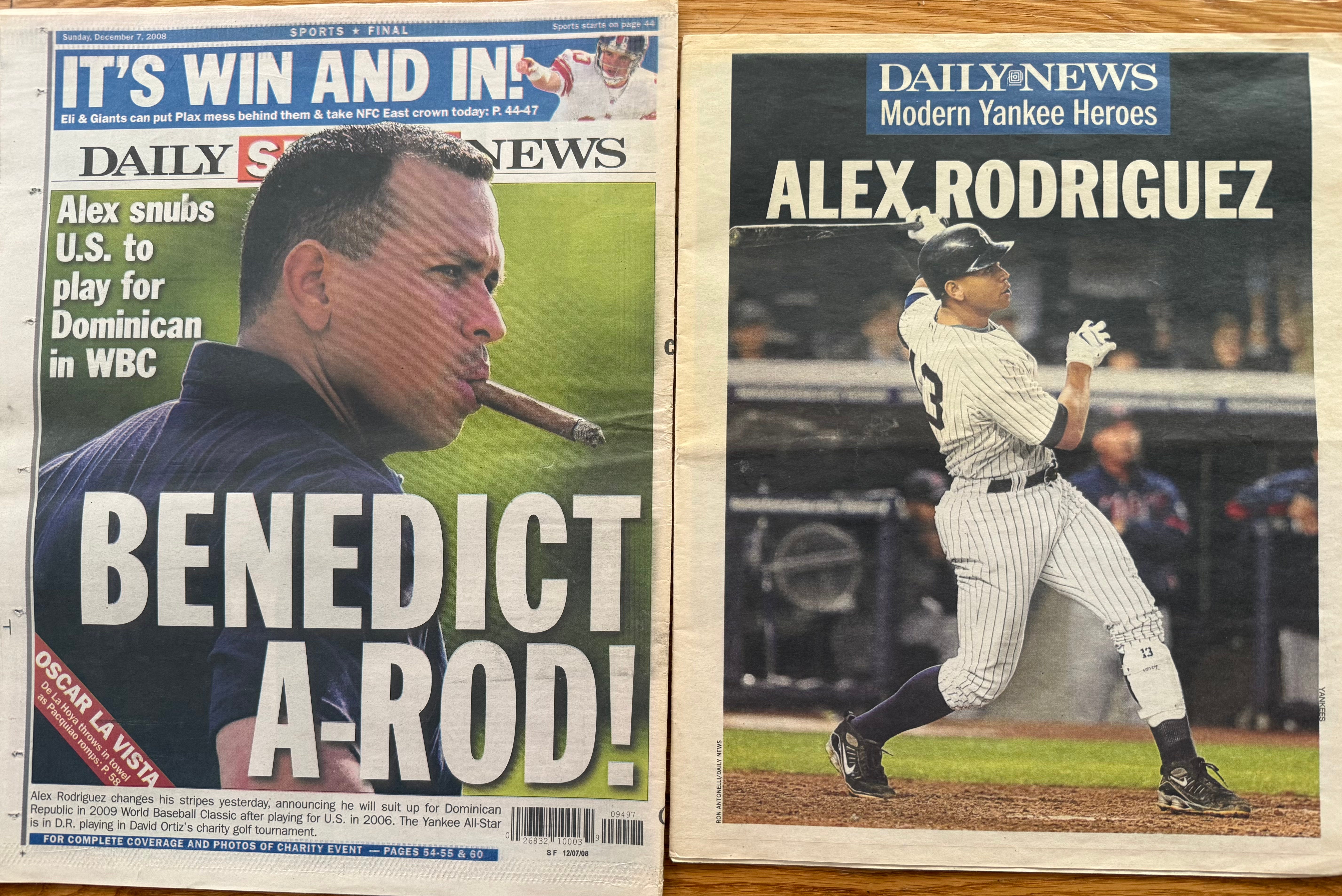
(Alex vs ARod in tabloid form. Two Daily News editions, 2008 and 2010, feature very different headlines)
“Alex said you really knew your stuff,” the Yankees media relations director Jason Zillo said as he passed me in the press box later that morning. But after the 20-page A-Rod special ran on April 4, 2010 (see above cover), you could say it was all downhill from there.
In the winter of 2013, Rodriguez was a guest of David Ortiz’s charity golf tournament in the Dominican, his first appearance at the event since back-to-back visits in 2008 and 2009. His arbitration hearing behind him, Rodriguez landed in Punta Cana to try and escape the klieg lights. The only problem was that a media horde (including me) was also gathered at the same Cap Cana resort to track his every move.


(Dominican snapshots. Alex Rodriguez makes an appearance at David Ortiz’s charity golf tournament in Punta Cana in 2013, only weeks after his arbitration hearing ended. Far r., baseball writers wait for A-Rod’s arrival.)
Moments after A-Rod arrived with then gal pal Torrie Wilson in tow, reporters scrambled to corner him for a soundbite. Rodriguez nearly escaped every media maneuver before we encircled him on an outdoor patio. The background music blaring didn’t help matters. Rodriguez barked at one of my questions, and he was still in the mindset that he would avoid a season-long ban.
(Media group interview with Alex Rodriguez in 2013 at David Ortiz’s Dominican charity golf tournament)
“I’m doing everything I can in my power to get ready for (2014) spring training. This is the best I’ve felt in any offseason in a long time,” he said.
The following day, the media had better success corralling A-Rod on a golf course, but he didn’t talk for long. The first question was from me about one of his social media posts, where he had visited with local youth baseball teams. Rodriguez didn’t respond kindly.
“You’re not gonna write that,” he said with a sarcastic laugh. Except that I did. When I showed Rodriguez the online story later that night at the Ortiz charity dinner gala, he tried his best to ignore me.
Almost a year later, I was in Miami reporting on the bombshell news about Rodriguez’s partial immunity agreement that he had signed months earlier. But while I was down there, I got word from my colleague Mike O’Keeffe back in New York that Yuri Sucart and his wife Carmen were ready to talk. I sped over to their Miami-area home and arrived just as a Newsday reporter was leaving. Yuri Sucart was bedridden at the time, but nevertheless willing to talk.
The ensuing hour or so with Carmen Sucart, however, was tabloid heaven, highlighted by her claim that Rodriguez had come to their house one time and urinated on a side wall. The acrimony between Rodriguez and his former personal assistant had only grown over the years.
At that point, in late 2014, Rodriguez was finished serving his suspension. But Yuri Sucart’s legal woes were still ongoing. In court documents, Yuri had allegedly tried to extort Rodriguez. On the flip side, Carmen Sucart claimed Rodriguez had promised to support his cousin after the latter was banned from all MLB clubhouses and training facilities. Instead, she said, Rodriguez came to the house in 2012 and asked the Sucarts to sign a confidentiality agreement in exchange for $50,000 and an apartment. Carmen refused. That was also the visit when A-Rod allegedly whizzed on their home.
[https://www.nydailynews.com/2014/11/14/alex-rodriguez-peed-on-our-house-he-is-the-devil-he-is-evil-says-cousin-yuri-sucarts-wife-carmen-as-she-fires-back-at-tarnished-yankees-slugger/]
“He is the devil,” Carmen Sucart said of Rodriguez during the 2014 interview. “He is evil.”
Neither Sucart was approached for the docuseries, according to Carmen, and there is still a family rift.
“Most of (Rodriguez’s) journey was with Yuri,” Carmen said in a recent interview, before trailing off. “He know what he did to my husband.”
While Rodriguez’s ex-wife Cynthia is part of the docuseries and the couple appears to be on cordial terms co-parenting their two daughters, Cynthia’s younger brother Constantine (known as “Taki”) created fissures in the family dynamic after he filed suit against A-Rod in late 2014.
The civil complaint stemmed from a real estate business the two men started in 2003. The younger Scurtis alleged that he was forced out of the company in 2008 — the same year Rodriguez and Cynthia divorced — and the younger Scurtis leveled multiple accusations against A-Rod, including breach of contract, breach of fiduciary duty, and unjust enrichment. There were also claims that Rodriguez and another business associate had committed insurance and mortgage fraud.
Scurtis sought millions in damages, and the suit threatened to bury A-Rod financially. Despite multiple motions to dismiss filed by Rodriguez over the years, the suit survived and continued to make its way through the court system.
The suit also outlasted A-Rod’s Yankee career, his romance and brief engagement to Jennifer Lopez, and his (and J-Lo’s) bid to buy the Mets.
By early 2021, Taki Scurtis and Rodriguez both switched counsel, and Scurtis’ new legal team amended the complaint to include explosive racketeering and civil theft charges. The presiding judge, Michael Hanzman, however, became more and more critical of the complaint during virtual hearings throughout 2021. He called the RICO claim an over-abused statute in civil matters, and referred to the case as a “distasteful dispute.”
Hanzman warned both sides that the case would be no nonsense, and would not become a salacious soap opera. “This court is not going to let the sideshow take over the circus. This case is going to be litigated as the real estate dispute that it is,” Hanzman boomed during one hearing.
Hanzman also didn’t care much for Rodriguez’s baseball career or otherwise.
“Maybe you are more easily starstruck than I am. (Rodriguez) is a baseball player who made a lot of money and is in the tabloids a lot because he dated J-Lo. Like I said, I could care less about any of it,” Hanzman said. “(Rodriguez) is a baseball player that has some celebrity status. That and $5 will get him a cup of coffee at Starbucks.”
The case was set to go to trial in late 2021, with some potential tantalizing components to the courtroom atmosphere, including portions of Rodriguez’s video deposition possibly being played to the jury.
One court filing revealed the plaintiff’s expert witnesses list, which included a clinical forensic psychologist who would potentially be called to testify on “the psychological analysis of narcissistic personality disorder and behavioral patterns.”
But at the eleventh hour, the two sides reached a settlement, and Hanzman dismissed the case with prejudice, meaning Scurtis could not refile at a later date. The terms of the settlement were confidential. Rodriguez’s attorneys issued a statement after the favorable outcome for their client.
“After Scurtis’ punitive damages claims were rejected, his thirteen derivative lawsuits were dismissed with prejudice, judgment was entered on his primary direct claims, three of his four expert witnesses were excluded, defendants’ potential exposure was drastically reduced the Friday before trial, and their claims for unpaid loans were ready to be presented to the jury, Mr. Rodriguez and Mr. (Stuart) Zook (another defendant) are satisfied with the outcome,” Benjamin Brodsky and Alaina Fotiu-Wojtowicz said. “Seven years after the case was filed, the record speaks for itself.”


(Two 2013 Alex Rodriguez snapshots — (l.) Rodriguez (No. 13) stretching before a game next to Mariano Rivera (No. 42); (r.) Rodriguez walking into MLB’s offices for his arbitration hearing later that fall)
It was the exact opposite outcome of Rodriguez’s legal blitz in 2013-14, which also included a lawsuit filed against the Yankees’ team doctor, Chris Ahmad. Rodriguez eventually dropped all of those suits and moved on. Similarly, after this legal war ended, A-Rod moved on, basking in his NBA/WNBA ownership status (Timberwolves and Lynx), his TV baseball analyst roles (ESPN and Fox), and, eventually, telling his life story on camera.
At one point during the Melvin interview on “Today,” the host referred to Rodriguez as a “recovering narcissist.”
“Well, I’m still recovering,” said Rodriguez.
Melvin then asked Rodriguez what the motivation was to make ALEX vs AROD, and suggested it was, perhaps, a bid to curry favor with Hall of Fame voters.
“Because the reality is, your numbers are better than 90% of the folks who are in Cooperstown, maybe this is part of a campaign to get into the Hall of Fame?” Melvin said.
“Yeah, that’s totally fair. I would go the other way, now that you saw (the docuseries). I’m definitely not going in the Hall of Fame,” said Rodriguez. “I knew the rules. I broke the rules. If that’s the penalty, that’s completely on me.”
Melvin played video of an interview he had with the late Hall of Famer Henry Aaron, and in it, Aaron said that he wasn’t opposed to steroid-linked players being inducted to Cooperstown. The clip finished and Melvin again asked Rodriguez point-blank if he deserves to have a Hall of Fame plaque.
“What say you? Do you deserve, yes or no, don’t couch it, do you deserve to be in the Hall of Fame?” asked Melvin.
“Of course,” said Rodriguez.
Maybe it is a baseball story after all.
Always impressed by the depth and insight of Street CRed pieces! As expected, this story did not disappoint, filled with objective analysis and color that only comes from decades of close-up coverage and expertise! Thanks!