
Charles In Charge
Carlos Beltrán's baseball career and legacy are cemented with his Hall of Fame election

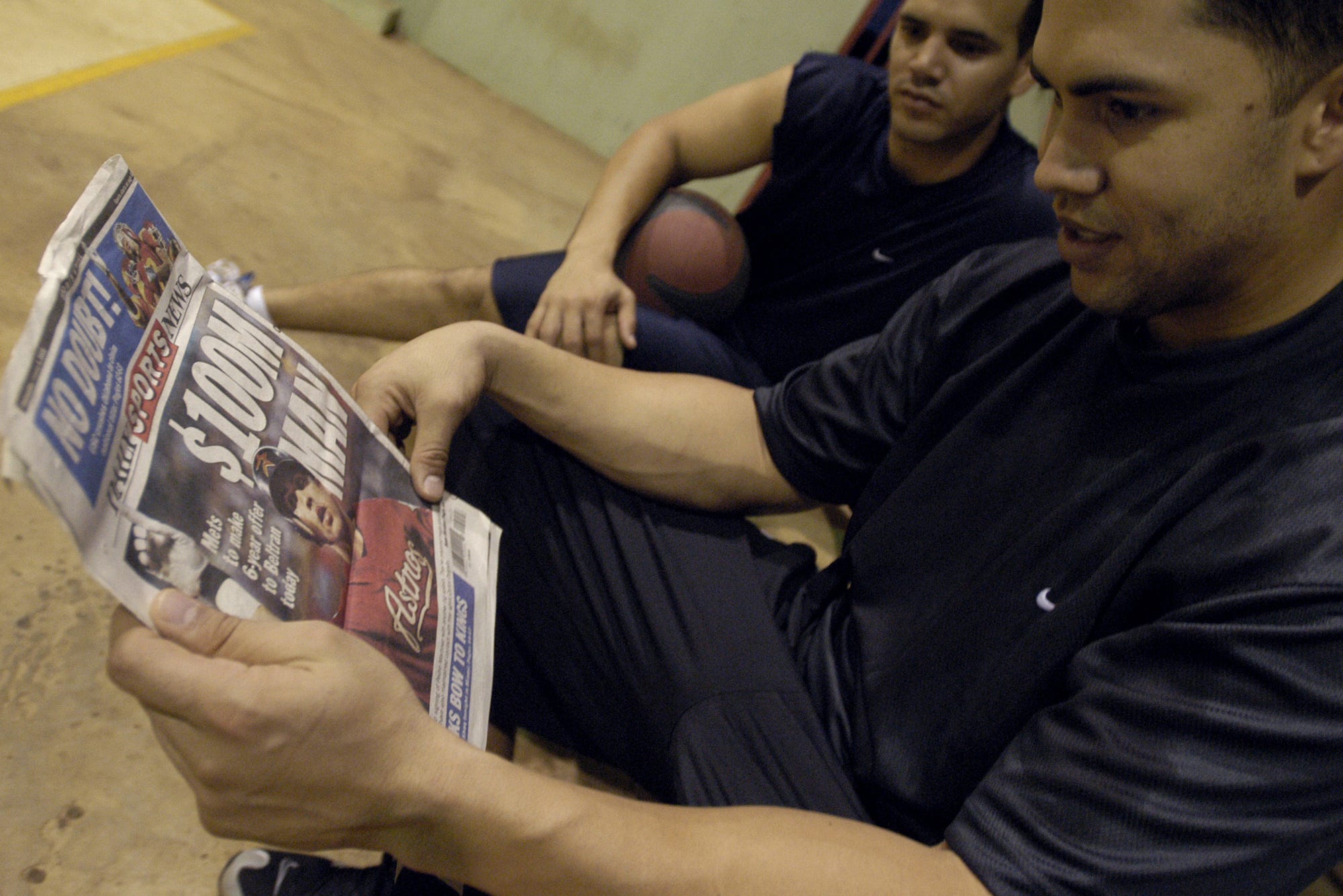
It started in an abandoned gym near his parents’ home in Manatí, the Puerto Rican northern coastal city west of the capital, San Juan.
Carlos Beltrán – fresh off an otherworldly 2004 postseason in which he basically carried the Houston Astros’ (still in the National League at the time) offense to the cusp of a World Series berth – was in the midst of a bruising workout session with his brother-in-law, launching a medicine ball against a wall and doing a SEAL-like set of lunges. When I walked into the gym with San Juan-based photographer Herminio Rodríguez, Beltrán looked at us suspiciously.
How the hell did you find me?
Only a few minutes earlier, Herminio – a stringer the Daily News had hired – and I had spoken with Beltrán’s parents, Carmen and Wilfredo, at their modest home. They had already entertained a few other reporters, mostly local P.R. outlets, since the pride of Manatí (their son) was one of the biggest Major League Baseball free-agent targets on the market. Through 12 division and championship series games, the switch-hitting Beltrán had whacked a combined eight home runs. He had a .455 average in the NLDS win over Atlanta and hit .417 in the seven-game NLCS loss to St. Louis.
Another jewel free agent, recently-crowned World Series champion Pedro Martinez, had just signed with the Mets, and the team’s new general manager, Omar Minaya, was pushing hard to get Beltrán to come to Queens, too.
Beltrán’s parents spoke humbly about their star baseball player son, but the only tangible evidence of Carlos Beltrán’s baseball career was a poster hanging in their garage. It was a rookie Beltrán wearing a Royals uniform – the club that originally drafted him in 1995 – and sporting a cheesy mustache. Like the other media lurking around Manatí, which included the rival New York Post, we all were trying to coax Beltrán’s whereabouts out of his family, but weren’t having much success. Carmen, the mom, was especially wary.
But as we were about to leave, Herminio stepped aside with Wilfredo privately, and they bantered in Spanish for a couple moments, exchanging laughs. Wilfredo, ever so subtly, motioned with his head in the opposite direction, and Herminio thanked him and then signaled for me to get in the car. Pronto.
“I think you are going to be happy,” Herminio said as I pulled the rental out of their driveway.
“Where are we going now?”
“Drive down this way a little…” Herminio said, trailing off as he stared out the passenger-side window. We drove about a mile before he blurted, “Here. Stop. This is it, I think.”
The derelict concrete building looked more like a Walter White lab than a place you would find an All-Star center fielder, and we had to walk through dense brush to get to an entryway. I had opted for flip-flops that morning. Poor footwear choice.
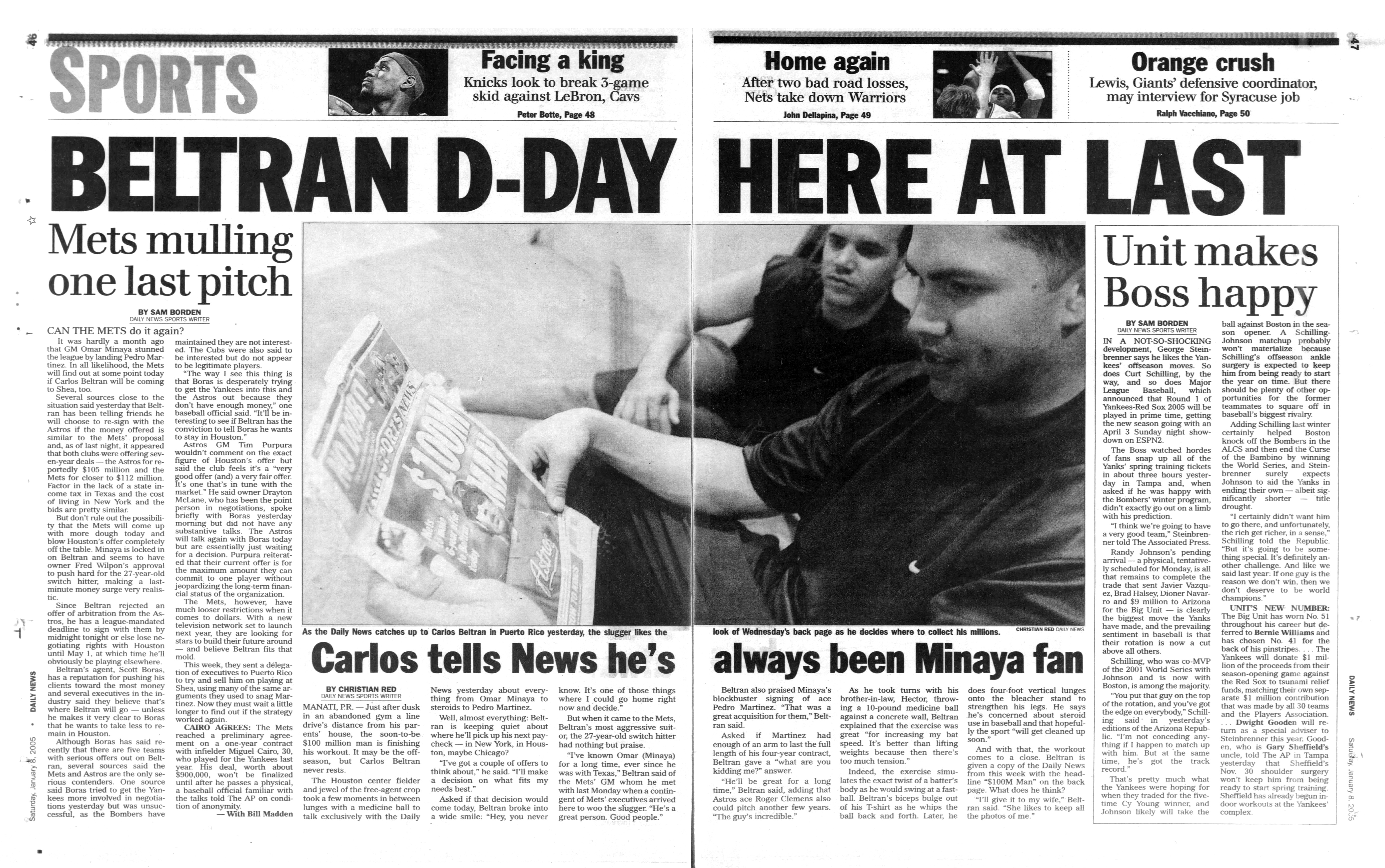
Beltrán and his in-law, Hector, were already drenched in sweat when we appeared, but after a couple beats, Beltrán warmed up to a brief interview. As we took a seat on some benches to the side, I showed him a copy of the Daily News from earlier in the week that I had brought to Puerto Rico. It had a back page photo of Beltrán in an Astros uniform with the headline, “$100M MAN” and the Mets’ multi-year offer to woo him. Beltrán smiled while looking at the newspaper, but wouldn’t divulge what his final decision would be.
“I’ve got a couple offers to think about,” he said. “I’ll make a decision on what fits my needs best.” I was totally unaware that Herminio had surreptitiously stationed himself behind me and snapped what would be the money photo – Beltrán holding the News back page.
As we left to go back to the hotel in San Juan, I asked Herminio if he had taken some good photos. He repeated the same refrain from earlier: “I think you are going to be happy.” I called the New York office with the “scoop,” and sports editors Leon Carter and Teri Thompson were apoplectic, especially with regard to getting Herminio’s photos. It was the pre-Twitter (X) days, so scoops of any sort were still golden.
Leon Carter was always issuing a “back page alert!” directive to all the News sportswriters, so hopefully this would fit the bill. There was also the perpetual worry that the Post would be first. Herminio and I were pretty confident our gym exclusive was the only one out there, but I redlined the rental car nonetheless. As it turned out, the story ran with Herminio’s exclusive photo… only I got credit in the photo caption instead of him. D’oh!
There was the small detail of where Beltrán would ultimately sign, and after filing the story and Herminio’s photos at the San Juan Marriott, I got back in the car a few hours later and drove back to Manatí by myself to loiter in Beltrán’s parents’ neighborhood. I didn’t have Beltrán’s home address, so I could only hope he’d sign with the Mets and celebrate at his folks’ house. While I was driving around the same block at night for the thousandth time, the heavens opened. And it was not some fleeting Caribbean shower, either, but a biblical deluge. Within minutes I was surrounded by a lake the size of Shea Stadium, and my puny rental car was a weak line of defense. I tried to make my way through the flood, but realized about ten feet in that I would be swallowed trying to drive further.
After an hour or so, with rain still coming down in buckets, I bagged my post and drove back to San Juan. Beltrán did sign with the Mets in that next 24-hour window and the following night, Sunday, Jan. 9, I was back at Beltrán’s parents’ crib, only this time Beltrán was there with the whole family, and his wife Jessica, to celebrate his seven-year, $119 million pact. I was with a different stringer photographer – Herminio had another commitment – and we were two of several reporters present during a party with music and champagne toasts, and even a pet monkey in the mix.
“It’s done. I really thank God this is the end,” said Beltrán. I heard later that Post reporter Brian Costello had flagged down Beltrán driving out of his apartment complex earlier in the day, so the Post beat the News on confirmation of the deal by several hours, though there was no social media posting that existed. Monday’s tabloid back page headlines were, essentially, a tie.
Beltrán’s debut season with the Mets wasn’t terrible, but his overall numbers (.266 average, .744 OPS, 16 home runs, 78 RBI) were much lower than his career averages in those and other categories. The Gotham glare definitely seemed to weigh on the soft-spoken Beltrán, as opposed to his teammate Martinez, who was every bit as garrulous and a showman on the field, like he had been in Boston. A snapshot of the different personalities: During Martinez’s first home start for the Mets at Shea, the infield sprinklers suddenly erupted during the top half of an inning. Martinez, unfazed, basked in the silliness of it.
Unfortunately for Beltrán, one of his signature 2005 moments – and also for former teammate Mike Cameron – was one both players would like to forget. During an August road series in San Diego, Beltrán and right fielder Cameron (who traditionally played center, but who was moved to the corner outfield position after the acquisition of Beltrán) converged on a David Ross bloop fly to right center. Both players dove for the ball at the exact same moment, and the result was a sickening head-to-head collision. Cameron and Beltrán lay in a heap afterward, Beltrán’s left arm draped over Cameron’s stomach.
Cameron suffered two fractured cheekbones, a broken nose and a concussion, while Beltrán had a facial fracture. “I just feel happy that I’m alive and that I’m going to be back on the field,” Beltrán told reporters a couple days after the incident. The ’05 season ended with no playoffs for the Mets – again.
But Beltrán took off during his sophomore season in Queens, and paired with new teammate and fellow Puerto Rican Carlos Delgado, the Carlos y Carlos show catapulted the Mets into the postseason. The two sluggers combined for 79 regular-season homers, and the club stormed to an NL East Division title. Mets fans were anticipating the franchise’s third World Series title, and everything seemed pointed in that direction until… Game 7 of the NLCS against the Cardinals.
The series went the distance and Game 7 at Shea came down to Beltrán’s ninth-inning at-bat with the bases loaded, two outs and his club down by two runs. The Mets seemed destined to win, especially after left fielder Endy Chavez earlier in the game had made a catch for the ages, robbing Scott Rolen of a homer and sending Shea into a frenzy. Even after Cardinals catcher Yadier Molina socked a no-doubt, two-run dinger in the top of the ninth, the Mets loaded the bases in the bottom half and had one of their best hitters poised to finish off St. Louis.
But facing Cardinals reliever Adam Wainwright, Beltrán watched an 0-2 curveball disappear into Molina’s glove for the final dagger, ending the Mets’ World Series dreams. I was covering that game with an army of News colleagues and Shea was as quiet as a funeral parlor following the called third strike. Beltrán’s bat lay on his left shoulder and the Cardinals erupted in celebration.
Brighter days seemed to be on the horizon for Beltrán and the Mets, however, as Minaya continued to upgrade the roster each winter. Instead, the team choked away a playoff berth in both 2007 and 2008. Beltrán’s productivity started to erode after 2008, with chronic right knee issues. Before the 2009 season began, I interviewed him at his Manatí home during a Puerto Rico work trip that was primarily centered around Bernie Williams and his World Baseball Classic last hurrah.
The side trip to visit Beltrán was a bonus. He had built a new mansion complete with a state-of-the-art gym and indoor batting cage – quite a step up from the 2005 interview in the abandoned concrete building. The Phillies had just won the World Series a few months earlier and some of their players – including pitcher Cole Hamels – had dissed the Mets and their choking ways. Beltrán took it all in stride during the interview, and put on a hitting clinic in his batting cage to show that he was gearing up for a Mets resurgence.


“This year is a new year. I still believe we have a great team,” said Beltrán. “If (Hamels) says those words – when you say words like that, you have to back it up. So he will be watched when he faces the Mets. And we take that as motivation to go out and play hard… I believe we have the potential to win a championship.”
Alas, the Mets finished fourth in the NL East in 2009 and 2010, missing the playoffs both years. Prior to the start of the 2010 season, Beltrán had January surgery to try and address his chronic right knee issues.
I traveled down to Port St. Lucie, the Mets’ spring training complex, in early May to interview Beltrán while he was rehabbing. Five years after he signed with the Mets, Beltrán was much more relaxed and media friendly, a quiet leader who found just as much joy in teaching Mets prospects and farmhands on a back field as he did playing for a chance to win a ring.
“I’m just happy that (the Mets) are doing good. The way they started the (2010) season, it wasn’t great. But now they were able to turn it around. Now they look good, with energy. Before, it looked like they were dead,” Beltran said during a break in his rehab workouts. “I hope that they continue to stay that way. But at the same time, yes, I want to be with them, I want to be able to experience what they experience. I’ve been able to play this game for 10 years, you still want to be in that situation where you are playing meaningful games.”
Beltrán addressed his treatment by Anthony Galea, the Toronto physician who would later plead guilty in federal court to bringing misbranded drugs across the border to treat clients. Beltrán said Galea never gave him performance-enhancing drugs, and he added that renowned Vail physician, the late Richard Steadman, had also treated his troublesome knee and had used an injection of Synvisc for pain relief.
“(Steadman) said to me that one of the areas of the bone bruise was good, and there was another area that was the same. I was hoping to hear that everything was getting better. They had me running on the treadmill for like, a minute. I couldn’t do it. Very painful,” Beltrán said.
He ended up playing in only 64 games in 2010, and by next season, with a new GM (Sandy Alderson) and a new manager (Terry Collins) in place for the Mets, Beltrán’s Flushing tenure came to a close after being traded to the Giants. One playoff appearance in six-and-half seasons as a Met. And the lasting memory of a frozen bat on his shoulder to end the 2006 postseason.
Beltrán would star for the Cardinals in 2012 and 2013, where he reunited with Wainwright. Although Johan Santana is credited with pitching the Mets’ first no-hitter in 2012, Beltrán was robbed of a hit in the sixth inning of that game at Citi Field. Replays showed Beltran’s liner down the third-base line hit the chalk, but umpires ruled otherwise. Santana’s no-no stood. Beltrán finally got to a World Series the following year, but his Cardinals fell to the Red Sox in six games.
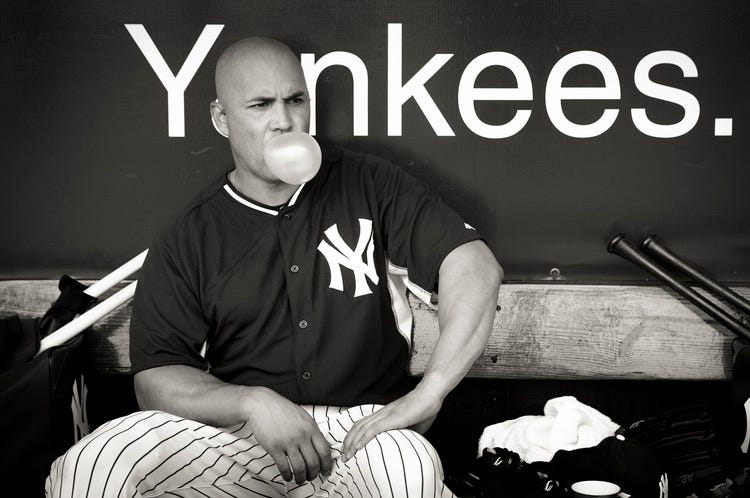
Then came the Yankee years. At 37, Beltrán was still a legit threat at the plate, but the Bombers were in a strange transitional stage in 2014 – Mariano and Pettitte were retired, Jeter was playing his final season, A-Rod was serving a season-long suspension, and the franchise was still adjusting to the post-George chapter with son Hal Steinbrenner at the helm. Even with future Hall of Famers CC Sabathia and Ichiro Suzuki on the roster, the 2014 Yankees finished second in the division and missed the playoffs for the second straight year.
After the 2015 Yankees got booted from the playoffs in the wild-card game, Beltrán made an appearance downtown for a charity event hosted by his former Mets teammate Julio Franco. The 38-year-old Beltrán said he felt like he could still contribute and was preparing for his final year in pinstripes (and perhaps his final season in the majors) with the same gusto as a rookie entering his first spring training.
(2015 group interview with Carlos Beltrán in downtown Manhattan)
That 2016 season seemed to signal a passing of the torch in Yankee Land. Beltrán was traded at the deadline to Texas, while the likes of Aaron Judge and Gary Sánchez led the Yankee youth movement. Beltrán had secured Hall of Fame credentials by then, with all signs pointing to retirement.
Until the Astros came calling (again).
In the now controversial 2017 Astros’ World Series title season, Beltrán was a key veteran cog during the club’s championship run. But a 2020 MLB investigation concluded that the 2017 Astros cheated their way to a World Series championship over the Los Angeles Dodgers, using an electronic sign-stealing scheme. Astros players were given immunity by baseball commissioner Rob Manfred during the investigation, but Beltrán was the only roster player named in the report and the fallout was costly.
Hired by the Mets as the team’s new manager in late 2019, Beltrán was poised to add to his MLB player legacy. But less than three months after the Mets named Beltrán manager, he was forced to step down in the wake of the MLB findings. He never managed a single game. (A.J. Hinch and Alex Cora, the Astros manager and bench coach, respectively, in 2017, were eventually hired again. Hinch, now the Tigers manager, served a year-long MLB suspension in 2020. Cora manages the Red Sox, but agreed with the club to “part ways” in 2020 after the MLB findings were released).
When Beltrán first appeared on the baseball writers’ Hall of Fame ballot, the debates began as to whether he was deserving of election to Cooperstown with the cheating scandal on his resume. Like some of his contemporaries whose legacies are tainted by steroid/PED links, Beltrán shouldered a different kind of scarlet letter that influenced voters’ decision making, myself included.
Full transparency: I voted for Beltrán (and Andruw Jones) on the latest HOF ballot, but I wrestled with the sign-stealing scandal the first three years of Beltrán’s eligibility. (Jones’ own candidacy was clouded with a 2012 domestic violence case, when charges were brought against him. Jones eventually pleaded guilty).
But now Beltrán (and Jones) are the newest Hall of Fame members (along with Jeff Kent, elected by the Contemporary Baseball Era Committee) to be inducted later this year. For Beltrán, it’s a deserving honor, despite the 2017 Astros’ link.
The arguments will continue — that an asterisk needs to be affixed to Beltrán’s World Series championship or that Beltrán’s Mets tenure was defined by a postseason strikeout. The supporters will point to Beltrán’s glittery stats — he’s one of only five players with at least 400 home runs and 300 stolen bases — as well as his off the field charity contributions and overall character. One of Beltrán’s many accolades includes baseball’s prestigious Roberto Clemente Humanitarian Award, which he received in 2013.
What isn’t debatable anymore is whether Beltrán’s plaque should hang in Cooperstown. It will.
Outstanding! Incorporating Navy Seals and Walter White. Any update on Herminio?