

Horse trainer Cherie DeVaux took a little air out of the tires earlier this month when she announced 2026 Kentucky Derby winner Golden Tempo would not race in the Preakness, the second leg of horse racing’s Triple Crown.
“Golden gave us the race of a lifetime in the Kentucky Derby, and we believe the best decision for him moving forward is to give him a little more time following such a tremendous effort,” DeVaux, the first female trainer to win the Derby, said in a statement. “(Golden Tempo’s) health, happiness and long-term future will always remain our top priority.”
Good for Golden Tempo, who gets a lengthy rest before he’s scheduled to race in the Belmont Stakes (this year held at Saratoga Springs). A horse’s health should always come first. But after the DeVaux announcement, there’s no doubt that the Preakness became an instant backburner sporting spectacle with no Triple Crown contender in the field. Napoleon Solo – no relation to Han – scampered to a win at Laurel Park (the 2026 Preakness host track while Pimlico is under renovation), and barely garnered headlines during a weekend that also featured the PGA Championship, baseball’s regular-season Subway Series between the Yankees and Mets, and the NBA and NHL playoffs vying for sports fans’ attention.
I’ve been lucky enough to cover two Triple Crown winners – 2015 champion American Pharoah and 2018 champion Justify – and have been smack in the middle of the euphoria afterward: the pungent amalgam of dirt, manure and sweat near the winner’s circle; the winning jockey basking in victory, while reporters, horse owners, trainers and everyone else navigates a tiny patch of real estate similar to quicksand (I learned the hard way why you shouldn’t wear nice shoes to a horse racing event).


But nothing will compare to the drama of 2008, when the colt Big Brown made a bid to join the likes of Secretariat, Seattle Slew and Affirmed, only to come up short. Way short.
Between Hall of Fame jockey Kent Desormeaux, who was aboard Big Brown, and the colt’s trainer Rick Dutrow Jr., those five weeks had enough storylines to fill a TV miniseries. There was Desormeaux, the Louisiana-born jockey, who had already come thiiiissss close to winning the Triple Crown a decade earlier aboard Real Quiet. But the 1998 Belmont ended with Victory Gallop besting Real Quiet by a literal nose. Now Desormeaux had another chance – a foregone conclusion? – riding Big Brown, the massive colt who began the 2008 Triple Crown season steamrolling the competition in the Derby and Preakness.
And there was Dutrow, the son of famous Baltimore-area trainer Richard Dutrow Sr. The younger Dutrow’s rise in his profession was a rags – at one point early in his trainer days, he lived in a tack room at Aqueduct – to riches story arc, replete with the kind of “you-can’t-write-this-stuff” tabloid fodder: murder, drugs, family rifts, personal and professional setbacks, fame, adulation, wealth, but ultimately, no Triple Crown brass ring.
“We were hoping for a much different outcome. I don’t know what happened, how to explain it,” Dutrow, now 66, said in a recent interview, all these years later after Big Brown pulled up on the last turn at Belmont and failed to finish the race.
“What do you mean what happened?” Desormeaux barked in a separate interview recently. “No hoof, no horse.”
Yes, Big Brown sustained a crack in his left front foot before running in the Belmont that year, but the injury didn’t prevent him from an attempt at horse racing glory. Turns out, there may have been several other factors at play for why Big Brown was denied victory, according to Desormeaux.
“The first jump, leaving the starting gate, the horse beside me (Guadalcanal) stepped on (Big Brown’s) foot and (knocked) his shoe off,” said Desormeaux, now 56. “And unfortunately for Big Brown, he was already milking to get to the race. He almost didn’t run it.
“I pulled him up (on the final turn). I almost stopped him, but I didn’t want anybody to think that he had broken his leg,” Desormeaux continued. “I let him canter. I’m so mad at myself for doing that. You could have followed Big Brown back to his barn by the blood drippings from his foot. That is a fact.”
Also undisputed was how dominant Big Brown was in the first two Triple Crown legs. I covered my one and only Derby that year – a trip memorable for many reasons, not the least of which was working alongside the late, great Daily News columnist Vic Ziegel and horse racing writer Jerry Bossert. In Louisville, the horse lived up to the hype, ditching the field in the mile-and-a-quarter race. The Big Brown victory was overshadowed in an instant, however, when the runner-up, filly Eight Belles, fractured both her front ankles after the finish and had to be euthanized immediately.
In the lead-up to the Preakness, I visited Desormeaux at his Garden City, L.I. home for an interview, rain pelting down outside. The lousy weather was the main reason I was able to get face time with the jockey. Desormeaux wasn’t one to sit around and relax – he wanted to be on the track preparing, but all of his races were scratched that day. His then (now ex) wife Sonia and the couple’s two sons, Joshua and Jacob, were also there. It was an emotional visit, as the younger Jacob has Usher syndrome, a rare genetic disorder with no cure. Usher syndrome causes deafness and gradual vision loss.
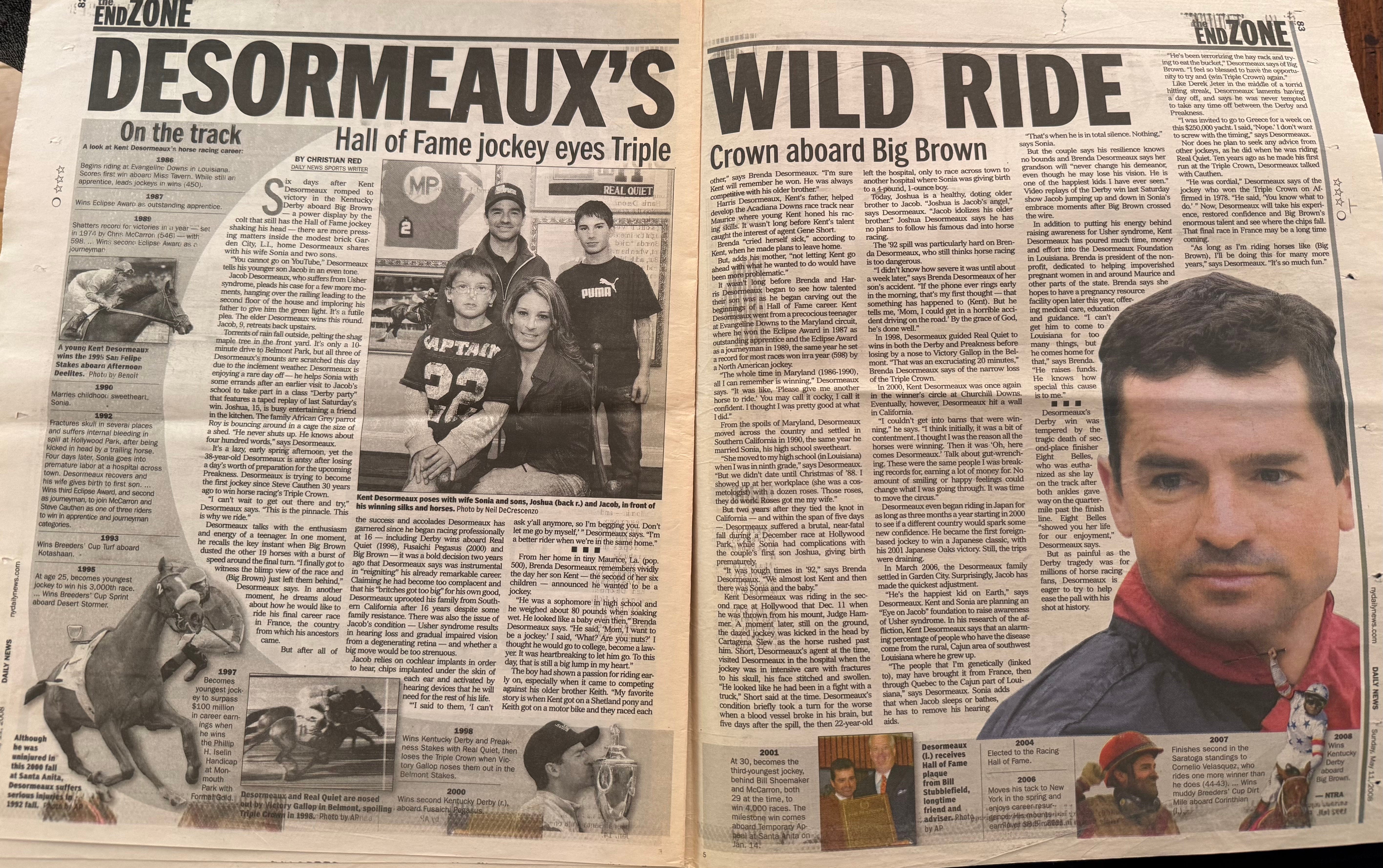
It was a raw, real look into the Desormeaux family dynamic – in one stretch, listening to Desormeaux recount his racing career and accolades, his confidence brimming, maybe bordering on cockiness. And then, in another stretch, watching something as simple as a father gently admonish a son (Jacob) for being on YouTube too long. During the visit, Kent and Sonia described the challenges of raising a child with a severe disability, and both got visibly emotional.
When the Preakness rolled around, Desormeaux was back in laser-focus mode, and rode Big Brown to another dominant victory in Baltimore, a race that the jockey still says today was one of the great rides in thoroughbred history.
“I think it was the most scintillating performance by a racehorse, probably as big as Secretariat’s Belmont win,” said Desormeaux in the recent interview. I told him that was some high praise.
“It is high praise – one of the most astounding performances with me onboard,” he added.
With the Derby and Preakness victories in the books, the spotlight turned squarely on Dutrow, and I was dispatched to write a feature on the horse trainer who called everybody “Babe,” and whose then cellphone voicemail message featured his daughter Molly’s voice saying simply, “Yeah, Dutrow” in a Spicoli-like tone.


But what began as a one-on-one interview with Dutrow outside Barn 2 at Belmont during the week before the biggest race of his career, soon turned into a trip north to Schenectady, and later, a drive out to Long Island to talk with Dutrow’s mother and daughter. Both trips packed an emotional wallop.
Schenectady was where Richard Vale lived. Vale, an engineer in the city that was once the General Electric headquarters, had become involved with Dutrow’s former girlfriend, Sheryl Denise Toyloy, after she and Dutrow split in the mid-1990s. Toyloy was already a mother to Dutrow’s daughter Molly when she moved in with Vale, but her troubled drug past was something that Vale knew nothing about – at least, not in the early part of their relationship.
On March 12, 1997, Toyloy was brutally murdered in Vale’s home, the victim of a robbery that was partly hatched by Toyloy’s drug dealer, Patrick Jeanty. Toyloy’s connection to Jeanty stretched back to when she lived in New York City. When Vale returned to his home that evening, he was nearly beaten to death by Jeanty and the other two accomplices. Molly, only 2 ½ at the time, was in the home during the entire length of the brutal, violent episode.
News photographer Bryan Smith and I sat with Vale in his home as he retraced the most painful chapter in his life, and at one point, he slid a VHS tape into his recorder and played a video of Toyloy and the toddler Molly Dutrow, only a few months before Toyloy’s murder. Bryan and I had a tough time keeping it together, watching those images flickering across the screen, the tears welling up in Vale’s eyes. He had tried to win custody of Molly after the murder, but since he was not a blood relative, he had no standing.
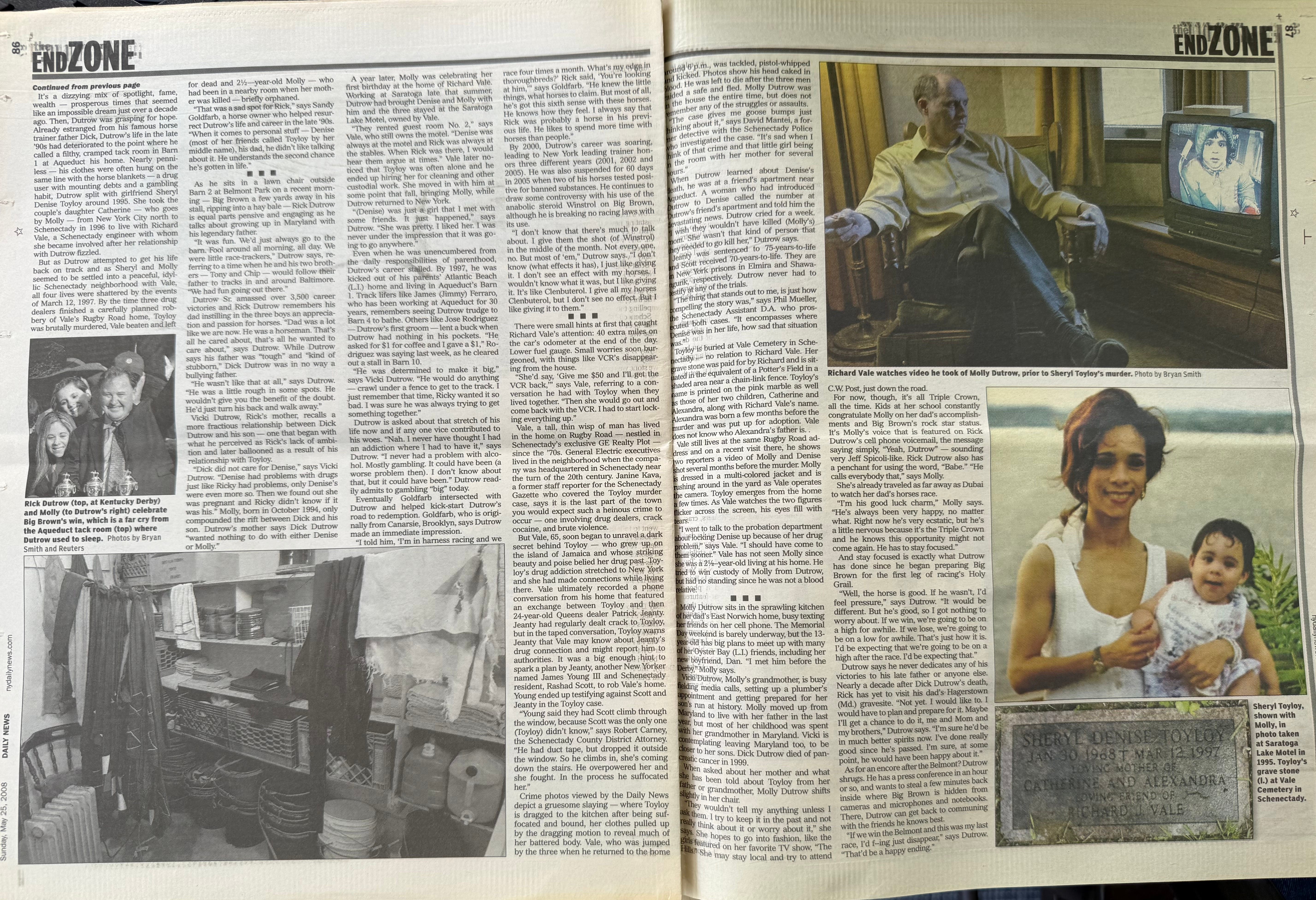
The then teenage Molly Dutrow was measured, but understandably guarded when I talked with her at Dutrow’s Long Island home. Rick Dutrow’s mother, Vicki, had already given the green light for me to ask her granddaughter Molly about her past, but even so, asking questions about such a heinous event made for an uneasy interview with both Molly and Vicki.
By her own admission, Vicki Dutrow said her late husband, Rick Sr., was never approving of his son’s relationship with Toyloy, and that it was compounded when Toyloy was pregnant with Molly. Dutrow Jr.’s own drug problems played into the father-son rift, too. Rick Dutrow Sr. died in 1999, before his son’s career success took shape.
By 2008, Molly had moved from her grandmother’s Maryland home – where she spent most of her childhood – to live with her dad, and had ambitions to go to college, and possibly work in fashion.
When the 2008 Belmont finally arrived, everybody was betting on Big Brown to blow away the field, including Giants defensive end Justin Tuck, who I saw among the pre-race masses.
https://www.nydailynews.com/2008/06/07/live-blog-big-brown-chases-triple-crown-at-belmont/
Dutrow had done his share of hyping his horse before the Belmont, and had even courted some controversy with his admission that he gave some of his horses Winstrol, the same anabolic steroid that Canadian sprinter Ben Johnson was busted for in the 1988 Olympics. (Winstrol, the brand name for Stanozolol, is banned in horse racing now).
“If we win, we’re going to be on a high for a while. If we lose, we’re going to be on a low for a while,” Dutrow said during one of my interviews prior to the ’08 Belmont. “That’s just how it is. I’d be expecting that we’re going to be on a high after the (Belmont). I’d be expecting that.”
Crowded with the other media at the rail, I watched as Big Brown tried to keep pace with eventual winner Da’ Tara until the top of the home stretch when, incredibly, Desormeaux eased the big horse to a canter. He never finished the race. The cheers were sucked into silence faster than you can say, “Yeah, Dutrow.”
“Still today, I can’t answer anything more than I did when I was there as it was unfolding,” said Dutrow recently. “I was looking for a problem and I never saw one. We were hoping for a much different outcome. But (Big Brown) bounced back, retired the right way.”
Dutrow was referring to Big Brown’s wins at Monmouth Park later that year – Haskell Invitational and Monmouth Stakes – before retiring.
“You throw up a little in your mouth,” Desormeaux said in the recent interview, when asked what it was like in the immediate aftermath of the Belmont loss. “It takes some heavy breathing. It was not my fault. It wasn’t the horse’s fault. It wasn’t him to blame, and it wasn’t me to blame. It just wasn’t meant to be.”
The two men forever linked by Big Brown are still working in their respective professions in the sport – Desormeaux lives in California and still races. After the 2008 Triple Crown coverage, I did a 2016 story on Desormeaux when he rode Exaggerator – whose trainer was Desormeaux’s older brother Keith – to victory in the Preakness.
Dutrow, meanwhile, served a decade-long suspension handed down by New York racing officials for medication and other violations, but returned to training in 2023, and is still based in the New York Metro area. Daughter Molly didn’t follow her dad into the horse racing business, although Dutrow hasn’t given up hope, yet.
“My mom is still living, she lives in Saratoga. My daughter’s going good right now,” said Dutrow. “We’re happy with both of them. I mean, there’s a hope, you know how that goes, a hope and a prayer (that Molly becomes a horse trainer).
“But I’m doing good, got around 50 horses, got plenty of clients, plenty of horses,” added Dutrow. “We’re doing good.”
Street CRed - once again you have captured so much more than a sports story. Thank you for your insightful and poignant writing. Can you please add some commentary on Shaq photo? He looks resplendent!